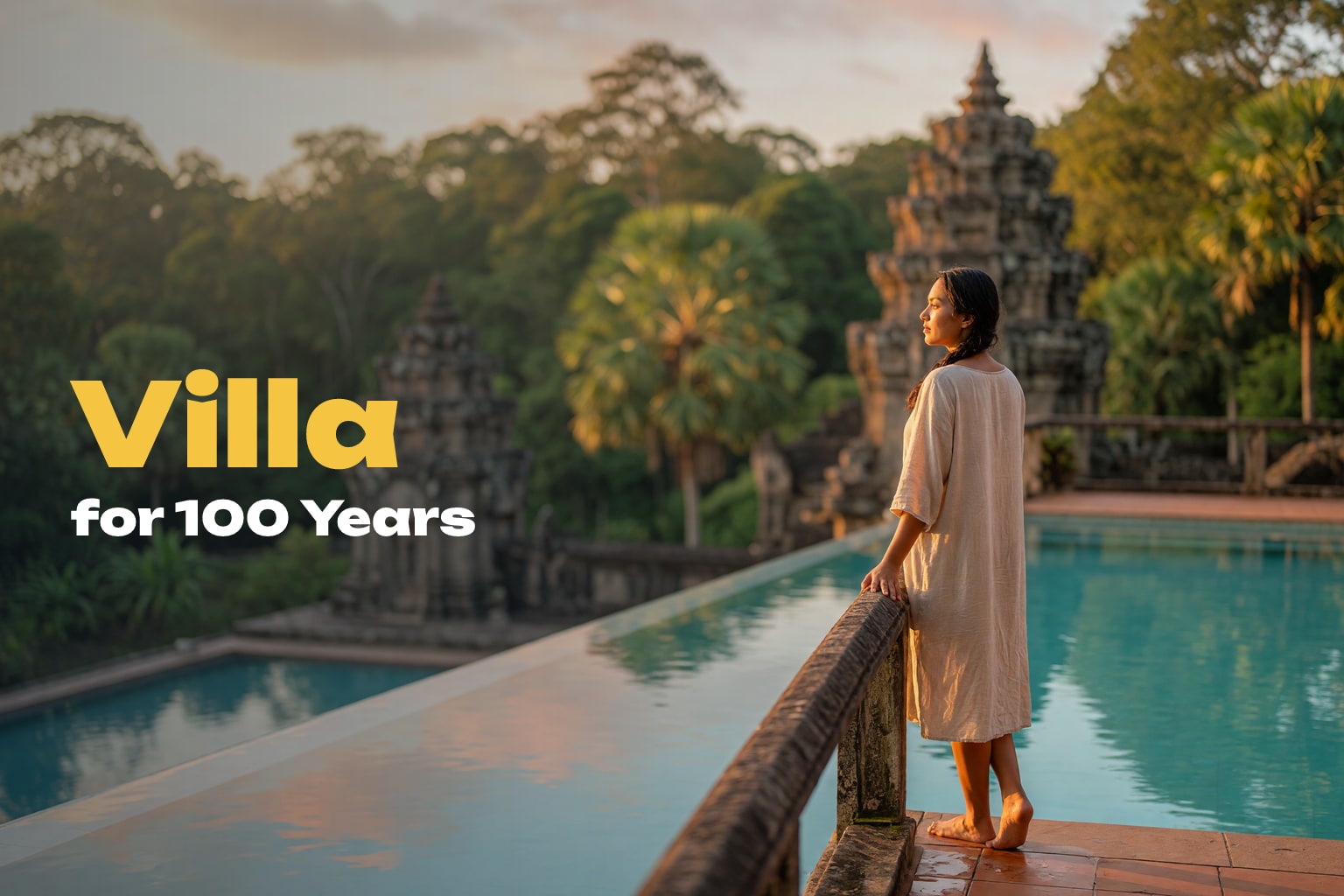
TL;DR: Foreigners cannot own land or villas in Cambodia directly. The safest structure is a leasehold arrangement through the developer, who holds the required 51% local stake and grants the buyer a formal lease agreement for 50 years with automatic renewal for another 50 — totalling 100 years. The property can be inherited for the remaining lease term.
Last updated: May 2026. This article is for informational purposes only and does not constitute legal advice.
Why Can't a Foreigner Simply Buy a Villa in Cambodia?
Cambodian law prohibits foreign nationals from owning land outright. Any villa — along with its plot — cannot legally be transferred to a foreigner's direct ownership. By law, at least 51% must be held by a Cambodian citizen or a locally registered entity.
The one notable exception: condominium units above the second floor qualify for freehold (strata title) ownership — full, indefinite ownership with no local partner required. But if a villa with a plot is the goal, leasehold is the only viable route.
Developer Leasehold vs. the "Local Friend" Scheme — What's the Real Difference?
The most common — and most dangerous — approach is to register a villa under a trusted local acquaintance: they hold 51%, you hold 49%. Legally, they are the owner. No amount of informal agreement protects you if they change their mind.
Developer leasehold works differently:
- The developer is a public legal entity with a verifiable track record of completed projects.
- They take the 51% local stake themselves and issue the buyer a formal lease agreement.
- Key terms are fixed in writing: duration, renewal, inheritance, and termination conditions.
- A developer with a portfolio has every incentive to honour the agreement — reputation and business continuity matter.
The real question isn't "leasehold or freehold" — it's who exactly holds your 51%.
A Real-World Example: Villa in Siem Reap
Siem Reap — Cambodia's tourism capital and home to Angkor Wat — is seeing growing interest from foreign buyers. Here's a concrete deal structure currently available:
| Parameter | Details |
|---|---|
| Property type | Villa |
| Price | $70,000 |
| Structure | Leasehold; developer = local partner |
| Term | 50 years + automatic 50-year renewal = 100 years |
| Extension beyond 100 years | Contractually referenced (no legal guarantee — legislation may change) |
| Inheritance | Yes — for the remaining lease term |
As of May 2026, this offering is available exclusively through select agents, without public listing.
Leasehold vs. Freehold: Which Structure Fits Your Goals?
| Parameter | Freehold (Condo 2F+) | Leasehold (Villa / Land) |
|---|---|---|
| Ownership duration | Indefinite | 50–100 years |
| Land included | No | In use (not owned) |
| Local partner required | No | Yes |
| Inheritance | Yes | Yes (remaining term) |
| Title document | Strata Title | Lease agreement |
| Risk level | Low | Medium (depends on partner) |
Leasehold is not a lesser option — for buyers who want a standalone villa with a garden, it's the only working framework. The critical variable is partner quality.
When Developer Leasehold Makes Sense — and When It Doesn't
Good fit if: - You want a villa, not an apartment. - You're looking at Siem Reap or other cities outside the main condo market. - The developer has a documented track record you can independently verify. - You're working with a local lawyer for due diligence.
Not recommended if: - The developer is new or unknown — no history, no reference points. - The deal is being structured through a "convenient" local individual with no legal standing. - You have no way to independently verify documents and the partner's background.
FAQ
Q: Can a leasehold villa be inherited? A: Yes. Heirs receive the remaining lease term under the existing contract. They do not become landowners, but usage rights transfer within the framework of the lease agreement.
Q: What happens after 100 years? A: Extensions beyond 100 years may be referenced in the contract, but carry no legal guarantee — Cambodian legislation could change. This is an honest limitation of the leasehold structure that buyers should factor into their decision.
Q: Why is a developer safer than a private local individual? A: A developer is a public legal entity with a business reputation, a project portfolio, and ongoing operations in the country. A private individual who legally owns 51% can act unilaterally at any point — and you have very limited legal recourse.
Q: How do you verify a developer before signing? A: Request a list of completed projects, review the company's registration documents, and check for active ongoing developments. Engage an independent local lawyer specialising in Cambodian real estate for a full due diligence review.
Find a property → nextoasis.io 🌐 Каталог объектов NextOasis