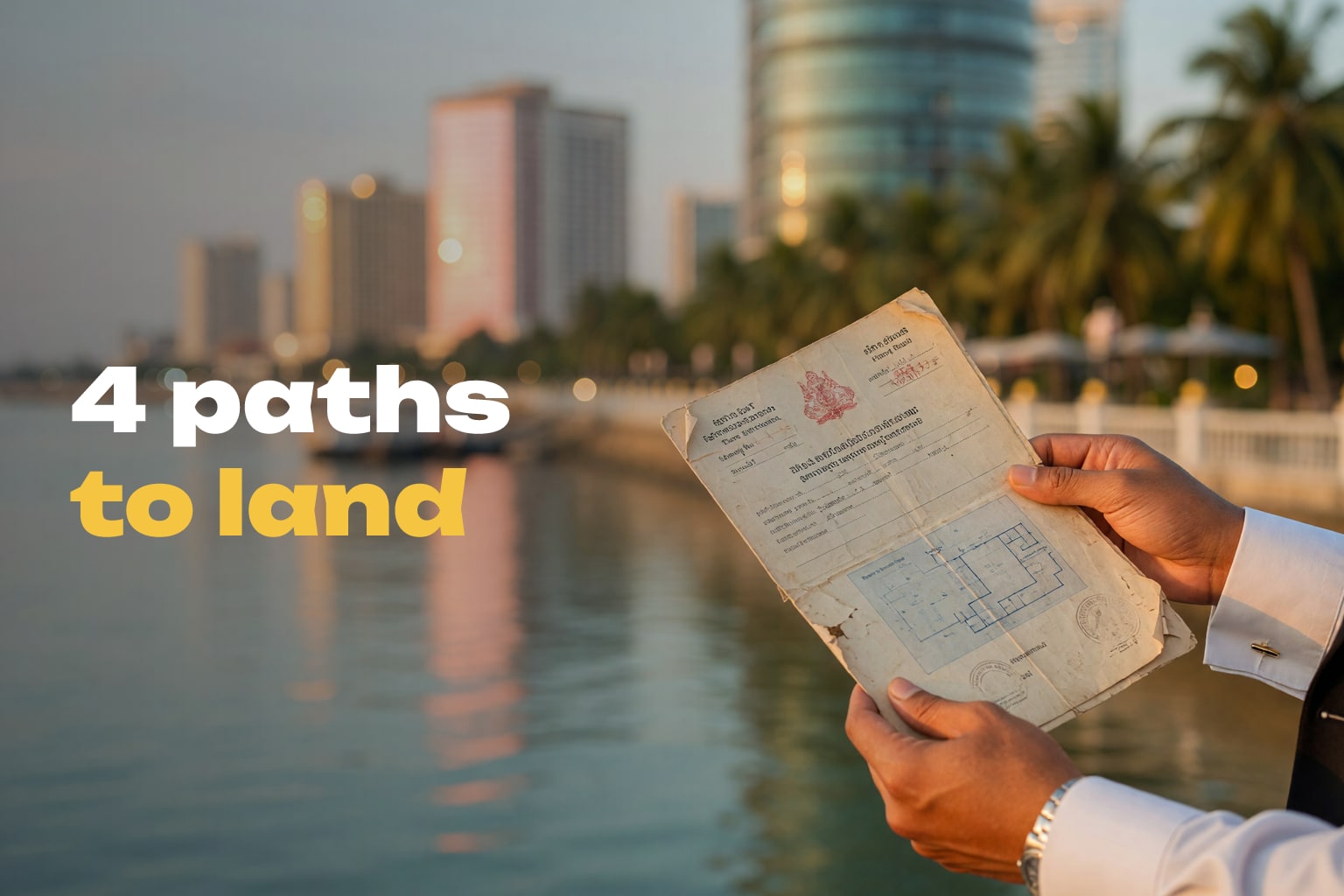
Can a Foreigner Own Land in Cambodia? Land Law 2001 ExplainedTL;DR: Foreigners cannot directly own land in Cambodia — this is prohibited by Article 8 of the Land Law 2001 and Article 44 of the 1993 Constitution. Violations result in asset confiscation with zero compensation. Legal alternatives include strata title, leasehold up to 50 years, a landholding company (51/49 structure), and the Cambodian Trust.
Information current as of 2025. This article is for informational purposes only and does not constitute legal advice.
Why Can't a Foreigner Own Land in Cambodia?
The restriction has a dual legal foundation that makes it particularly robust. Article 44 of the 1993 Constitution of the Kingdom of Cambodia reserves land ownership rights exclusively for Cambodian natural persons and legal entities. The Land Law 2001, promulgated on 30 August 2001, reinforces this in Article 8:
«Only Cambodian natural persons or legal entities have the right to ownership of land.»
This isn't a loophole or an oversight — it's a deliberate state policy rooted in Cambodia's post-conflict history. Article 7 of the same law clarifies that property rights existing before 1979 are not recognized. After the Khmer Rouge regime, all land was effectively reset to zero, which explains why most Cambodian land titles are relatively recent.
What Happens if a Foreigner Uses a Nominee?
This is the single most dangerous path for a foreign investor. Article 8 of the Land Law explicitly states that a foreigner who falsifies their national identity or uses a nominee to acquire land ownership faces criminal penalties under Article 251 — and the property is confiscated by the state with no compensation whatsoever.
Cambodian courts do apply this provision. The risk is not theoretical, especially during political audits or in the event of a dispute with the local partner who holds the title on paper.
What Are the 4 Legal Pathways for Foreign Investors?
While direct land ownership is off the table, the legal framework leaves four workable mechanisms:
1. Strata Title (Condominium Ownership)
Foreigners can own condominium units in full freehold — starting from the second floor and above. The legal basis is the Condominium Law of 2010. Key limitation: foreigners may collectively hold no more than 70% of units in a single building. The land beneath the building remains in Cambodian ownership; the buyer acquires only the strata unit itself.
2. Leasehold / Long-Term Lease
Cambodia's Civil Code permits long-term land and property leases of up to 50 years, with renewal options. For comparison, Thailand's standard leasehold runs 30 years. A registered lease with the Ministry of Land Management provides genuine legal protection for the leaseholder.
3. Landholding Company (51/49 Structure)
Article 9 of the Land Law: a company registered in Cambodia where at least 51% of shares are held by Cambodian citizens or legal entities is treated as a Cambodian entity and may own land. A foreigner can hold up to 49%. The structure is legally sound but demands a carefully drafted shareholders' agreement — that document is where most disputes originate.
4. Cambodian Trust
The Trust Law of 2019 created a mechanism allowing foreigners to effectively control land or a villa through a fiduciary structure. It's a relatively new instrument with evolving case law, but it is legal and state-registered.
Cambodia vs. Thailand: Key Differences for Foreign Buyers
Both countries prohibit direct land ownership by foreigners, but the details differ:
| Feature | Cambodia | Thailand |
|---|---|---|
| Direct land ownership | Prohibited | Prohibited |
| Condo freehold for foreigners | Up to 70% of building (2nd fl+) | Up to 49% of building |
| Maximum leasehold | 50 years + renewal | 30 years (+ 30 by agreement) |
| Local-majority company | 51/49 (Land Law Art. 9) | Thai majority company analogue |
| Trust structure | Trust Law 2019 | Not available |
In several respects — notably leasehold duration and the foreign ownership cap in condominiums — Cambodia offers slightly more flexibility.
Key Due Diligence Checklist Before Buying
- Verify the title type — hard title (full state registration) vs. soft title (informal rights). Only a hard title provides complete legal protection.
- Avoid grey-area schemes — even if an agent insists «everyone does it.» If the property is seized, the agent bears no liability.
- Register the leasehold — an unregistered long-term lease is legally vulnerable, particularly if the landowner changes.
- Draft the shareholders' agreement carefully in a 51/49 structure — covering buyout rights, decision-making procedures, and exit terms.
- Consult a locally licensed Cambodian lawyer, not just a real estate agent.
FAQ
Q: Can a foreigner married to a Cambodian citizen own land? A: Not directly. Land ownership remains with the Cambodian spouse. The foreign partner does not acquire automatic rights to the land. Legal instruments such as a marriage contract or supplementary agreements are recommended to protect the foreign party's financial interest.
Q: What is strata title and how does it differ from freehold? A: Strata title is ownership of a specific unit — an apartment — within a multi-storey building. The foreigner owns the unit but holds no share in the land beneath the building. It is full ownership, but limited to units above ground floor level.
Q: Is a 50-year leasehold secure? A: Yes, provided the agreement is registered with the state land registry. A registered leasehold is legally protected and inheritable. An unregistered lease is significantly more vulnerable, especially if the landowner transfers or sells the underlying title.
Q: Can a foreigner set up a company in Cambodia and use it to purchase land? A: Yes — through a landholding company under Article 9 of Land Law 2001. The mandatory condition: at least 51% of company shares must belong to Cambodian citizens or legal entities. A foreigner may hold up to 49% and, with a well-structured shareholders' agreement, can retain meaningful operational control.
Find a property → nextoasis.io 💬 Telegram channel · property@nextoasis.io